
When Steve Tice first described his idea to fellow RVers at the resorts where he and his wife stay, the reaction was nearly unanimous.
"They said, you know, you're nuts," he says. "That's a James Bond vehicle. You'll never be able to create it."
His answer was two words: "Watch us."
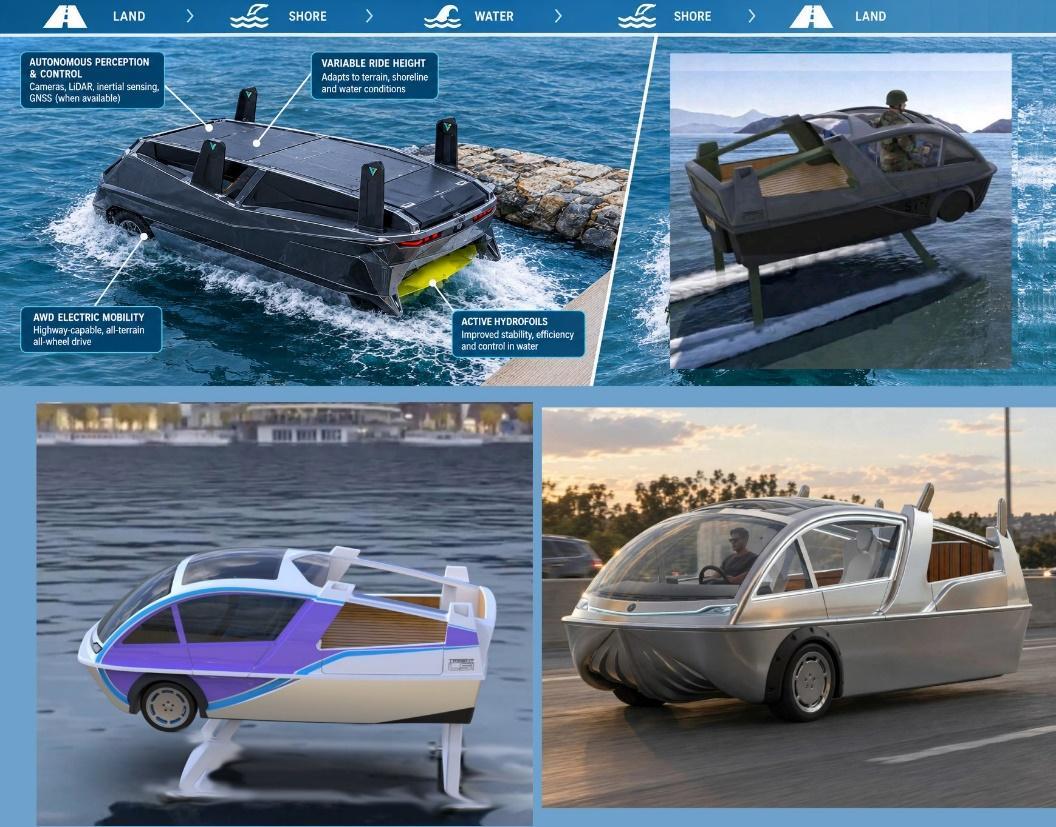
The vehicle is the Trident, an all-electric, highway-legal vehicle that drives off a beach or launch ramp, rises up on hydrofoils, and glides across the water. The company building it is Poseidon AmphibWorks, the latest venture from an engineer who calls himself "a glutton for punishment" after 40 years of back-to-back startups.
"There's always roller coaster rides," he says.
From flight simulators to the first 3D console games
Tice started in aerospace at Rockwell International in Downey. His first company, SimGraphics Engineering, took real-time flight simulation technology and made it useful for designers - something almost nobody was doing at the time, because it took custom software built from scratch.
That work led to Hasbro, where Tice's team designed and built prototypes of what he describes as the first virtual reality system, and he managed the first 12 developers building 3D games for it. This was the era of Pac-Man and side-scrollers. "As far as 3D games on a console, it was never heard of," he says.
The project ended after Hasbro had spent around $58 million and a new CFO decided they wouldn't make money on the hardware. Tice and team had told them as much from the start. "This is a software business," he says. "You lose money or break even on the hardware."
Out of that came QuantumWorks, his engineering company since 1994, and eventually a move into converting vehicles to electric powertrains - semi trucks (he and partner led the engineering and development of the Nikola series PHEV semi-truck, which involved many innovations the public never saw), mining trucks, even a Corvette that set records on the runway at Kennedy Space Center. Along the way he co-founded EVDrive with a partner in Oregon.
The gap nobody was filling
Through all of it, Tice kept watching for a niche that matched his own interests and that nobody had really explored. Around 2019 and 2020, he found it in high-performance electric marine. Outside of trolling motors, almost no one was doing it.
Inside that space he found an even emptier corner: amphibious vehicles.
Tice partnered with a worldwide amphibious vehicle expert in Miami who had used gas-powered amphibious vehicles for flood rescue. That partner walked him through every reliability and maintenance problem with the existing options and told him the market was ready for an electric amphibian engineered the right way.
By 2021, he saw a "perfect storm" forming. Electric drivetrains had matured. A Swedish company called Candela had proven an electric hydrofoil boat could work. Drone flight controllers and sensors had become good enough to fly a vehicle on foils. QuantumWorks spun off the Poseidon start-up to build it for the recreational and commercial space. Tice and team designed multiple iterations of the concept to date, each a bit closer to the customers needs..
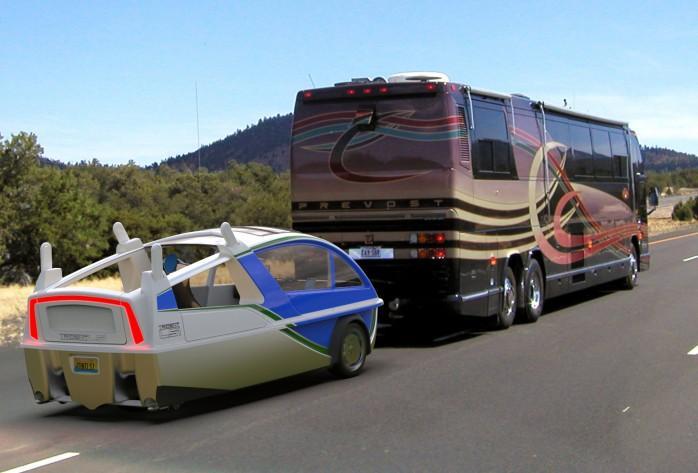
The spark was personal. Tice and his wife are longtime RVers who enjoy traveling in a Class A motorhome. Big rigs like that stay parked at camp, so owners tow a small car behind them - a "toad" - to get around. But no electric car can be flat-towed (no trailer).
"I'm a practical EV evangelist," Tice says. "I don't think it's EV for all. I think EV is a choice to match specific customer needs." For RVers, the EV choice didn't exist. And if you were going to build a towable EV, why not one that was also a boat, to avoid awkward and dangerous trailers to tow both an EV and a boat?
Four markets, one vehicle
The Trident is about the size of a Tesla Model X or BMW X5 - roughly 16 feet long and seven feet wide, with seats for three or four and an open deck in back (that can even fit 4x8 sheets with tailgate closed). RVers were the first market. Then the list grew.
After talking to small boat owners, that opened a second market: new recreational boat owners who don't want to pay for a slip or risk the known trailering disasters at the launch ramps. A Trident charges at home and fits in a one-car garage; no additional space needed.
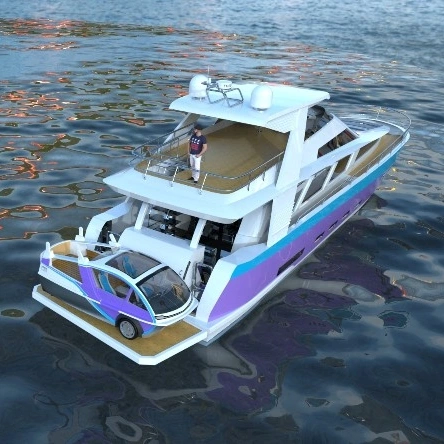
A third market came from yacht owners, and especially yacht crews, who constantly shuttle to shore for provisioning. Instead of taking a tender to a public dock and renting a car, they could drive straight up the beach and onto the road and highway.
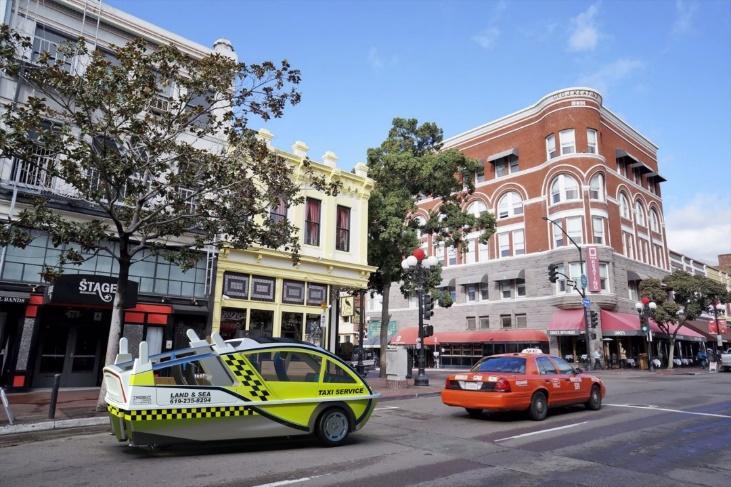
The fourth market came from Poseidon's 2022 crowdfunding campaign. Some of the small investors lived on large lakes and already used boats to skip traffic on two-lane roads. Further out, Tice sees water-adjacent cities where a vehicle that can cut across a river or lake could transform a commute. Another valuable use is for search and rescue for the more dangerous floods happening around the world . Injured individuals could be treated enroute to shore and driven directly to the nearest land-based medical facility, saving crucial time.
The hardest problem: two vehicles fighting each other
Tice is careful to be clear about where Poseidon stands. The full Trident exists in the computer, through seven design iterations. The one physical prototype the team has built is the hardest piece: the flight control system for the hydrofoils, designed to scale to larger future models.
The core engineering challenge is that the two halves or powertrains of the vehicle want opposite things. On the road, the Trident is a reverse trike - two wheels in front, one in back - which wants its weight more toward the front. On the water, the hydrofoils want the weight centered.
Road safety wins. So the Trident uses a cab-forward design that seats everyone up front, and the team over-designs the front foil to carry more load than the back. Fully submerged hydrofoils make the ride on the water smooth. "Anybody that's been on a hydrofoil vehicle said, 'Oh my God, I'm not getting seasick anymore, what a game-changer,'" Tice says.
Weight and cost drive everything else. The hull uses aluminum and marine HDPE, a rugged thermoplastic that won't shatter like fiberglass. If it hits a rock it deforms, not cracks and in the unlikely event of a crack, can be repaired in the field with a plastic welder. Tice is a believer in the right to repair. "We're not going to be like traditional automakers that say you can't touch anything," he says. Dashboard units can be owner upgraded, upper body panels can be 3D printed with the look any owner desires. Existing highway-legal amphibious vehicles (only gas-powered available) sell for more than $200,000; Poseidon is targeting the $135,000 range for a combination EV and hydrofoil boat.
One of their advisors once worked at the National Highway Traffic Safety Administration and helped bring the Polaris Slingshot through regulations. He is guiding the design right from the start, so it can be certified as an autocycle with least cost and time delay.
What's next
This year brought an unexpected new direction: interest from the military. Tice describes a priority called “Contested Logistics” - getting supplies from ships to shore and inland without putting people at risk. Drones fly and unmanned boats sail, but there is very little in the way of small, autonomous vehicles that can come out of the water and drive a payload down a road.
An unmanned Trident could do exactly that, using the same powertrain and hydrofoil core. "It turns out that the commercial, recreational, and the military are based on the same format, the same technology," Tice says. Poseidon’s, lead investor QuantumWorks has started sending white papers to potential DoW groups on that use.
Over the next 12 to 18 months, the goal is funding on both tracks - and, once it lands, a full-scale demonstration at one of Florida's big superyacht shows.
The doubters at the RV park may still think it's a James Bond fantasy. Tice has heard that before, across four decades of building things people said couldn't be built.
"I think the tech and the customer demand are there," he says. "Once they see it, I think we're ready to supply the demand."
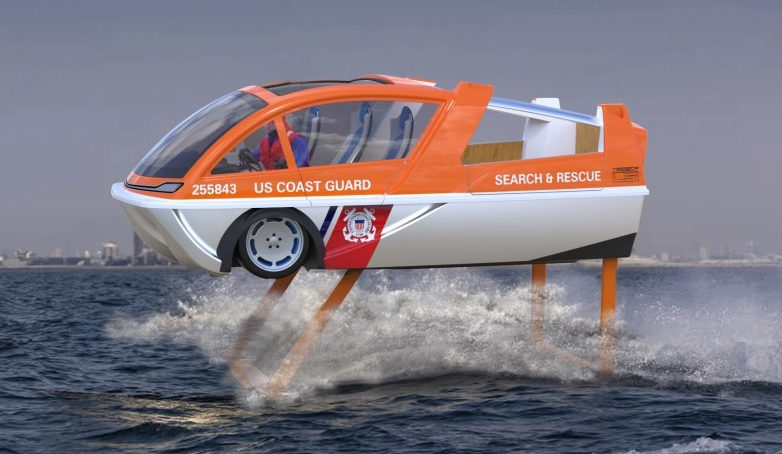
Poseidon AmphibWorks is developing the Trident LS-1, the first in the planned product line, an all-electric (hybrid option), highway-legal amphibious vehicle with active hydrofoils, spun off from Steve Tice's engineering firm QuantumWorks. Learn more at pre-seed.poseidonamphibworks.com.
Built in San Diego is a free feature series by Revvia that tells the stories of the real people behind San Diego's local businesses - the founders, the operators, and the builders who make this community worth living in. Every feature includes a professionally written article, a live backlink, and an owner's story told the way it deserves to be told.


